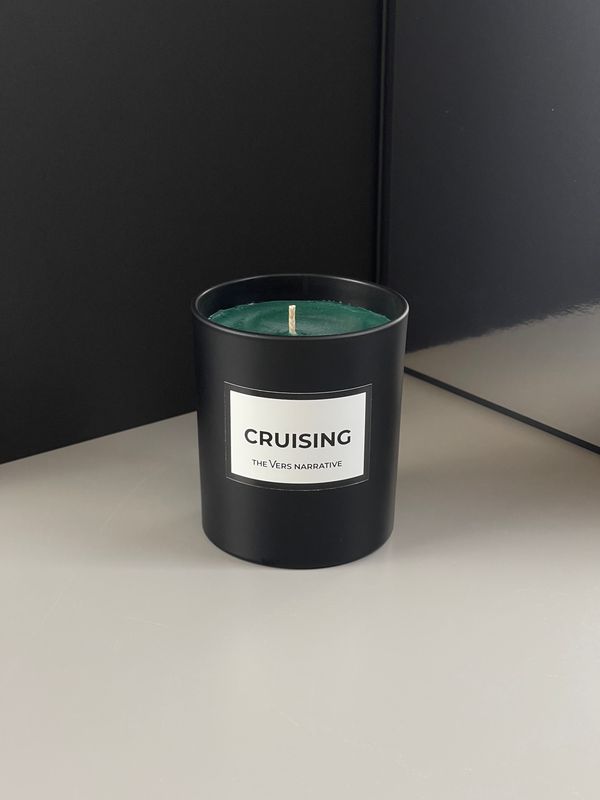
Cruising:
The Art of Moving Desire
There is something primal in a glance – in that moment when eyes meet in a dimly lit park, a hidden alleyway, or a fleeting encounter in a crowded club.
Cruising is more than the mere pursuit of physical intimacy; it is a dance, a ritual, a silent negotiation between bodies and desire. It is both transgression and transcendence, a reclaiming of space and a declaration of existence.

© 2025 R. Lysander. All rights reserved.
Historically, cruising emerged out of necessity. In times when queerness was criminalized, public spaces transformed into secret arenas of longing, coded signals, and whispered invitations. The clandestine nature of cruising turned it into an act of resistance, a way to experience intimacy where it was forbidden. Yet, beyond mere survival, cruising holds profound philosophical meaning—it is lived freedom, a rejection of heteronormative scripts, and an embrace of impermanence.
The Philosophy of Fleeting Encounters
Unlike traditional forms of dating, which often strive for permanence (labels, commitments, stability) cruising exists in the realm of the ephemeral. Philosopher Jean-Luc Nancy speaks of "being singular plural," the idea that our existence is inherently relational, that we are shaped by fleeting encounters. In this sense, cruising is an ode to transience, a celebration of the moment rather than the expectation of continuity. It is desire without possession, connection without obligation, pleasure without the constraints of predetermined narratives.
Roland Barthes described eroticism as something that thrives on absence and ambiguity. Cruising operates on this very principle, on anticipation, proximity and the unspoken agreement that the moment itself is the destination. It is desire in its rawest and most poetic form.
Benefits of Cruising
Often dismissed as mere hedonism, cruising actually offers demonstrable psychological and social benefits. Research on sexual health and psychology shows that casual encounters can enhance overall well-being—provided they occur consensually and safely. A study published in the Journal of Sex Research (2014) found that individuals who engage in consensual non-monogamous encounters, including cruising, tend to report higher levels of sexual satisfaction and self-esteem compared to those who strictly adhere to monogamous norms (Conley, Moors, Matsick & Ziegler, 2014).
Beyond personal fulfillment, cruising fosters a unique form of social connectivity. Anthropologist Samuel Delany, in Times Square Red, Times Square Blue, describes how these spontaneous encounters create unexpected networks of intimacy and solidarity. The immediacy of cruising builds bridges between strangers, offering a sense of community often absent in structured social interactions. In a world increasingly dominated by digital mediation, where desire is filtered through algorithms and dating apps confine attraction to preordained patterns, cruising restores the physicality of presence, the thrilling uncertainty of the unknown.
Cruising as a Political Act
To cruise is to claim space, to assert the right to desire freely and unapologetically. It is an act that challenges capitalist and heteronormative structures that seek to regulate and commodify intimacy. At a time when LGBTQ+ rights remain under threat worldwide, the public expression of desire, especially beyond institutionalized norms, remains a radical gesture.
Even in societies that increasingly accept queerness, LGBTQ+ identity is often sanitized through "respectable" narratives of monogamy and domesticity. Cruising resists this domestication; it is a return to a wilder, freer mode of being.
The Poetry of Desire
Cruising is not just about sex. It is about movement, longing and the poetry of encounters. It reminds us that desire is not meant to be possessed or controlled but experienced. It is a practice of attentiveness, of reading the world and the bodies within it, an invitation to embrace uncertainty as pleasure rather than fear.
In a world that constantly demands definition, order, and predictability, cruising stands as a beautiful act of resistance. It invites us to step into the unknown, to find connection in the fleeting, and to lose ourselves in the transient magic of a gaze that lingers just long enough to mean everything.